
When I arrived in Manchester from Poland in 2006, I didn’t know what to expect. I had never even seen a picture of the city. In my head, I imagined a massive, vertical metropolis, a British Manhattan.
What I found was… different.
The city was gritty, industrial, and surprisingly flat. There was only one true skyscraper: The Beetham Tower. It stood like a lonely exclamation mark against a grey sky. It was impressive, but it felt accidental, a monolith dropped from space into a low-rise world.
I didn’t pick up a professional DSLR until 2012, but my passion for capturing this transformation started not long after I arrived. I have spent the last two decades watching Manchester catch up to my imagination. I’ve watched the worn-down industrial skeletons transformed into the foundation of a modern European power.


Manchester skyline captured in 2013
Fast forward to 2026, and the city I imagined in 2006 is finally here. Beetham isn’t lonely anymore; it’s the elder statesman in a crowded room.
The “Height Race” of the last decade has been thrilling, but as a photographer, I’m noticing a shift. The narrative isn’t about height anymore—it’s about character. The gaps are filling in, and distinct neighbourhoods are forming in the sky.
Here is how I see the three main players shaping this new visual era.
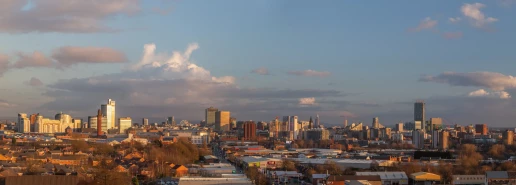
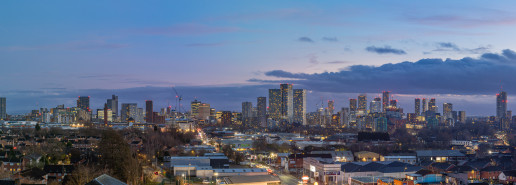
Progress between 2013 and 2026
1. The Connector: Muse (New Victoria)
For years, the area north of Victoria Station felt incomplete.
We had the beautiful, historic station on one side, and the modern NOMA district (with the iconic “Sliced Egg” Co-op building) on the other. But the space between them was a ga, a windswept car park that acted as a barrier, separating the commuter hub from the business district.
Muse didn’t just fill that gap; they stitched the city back together.
By building New Victoria right on the edge of the tracks, they created a visual bridge. Now, when you stand on Corporation Street, there is a continuous flow of architecture from the medieval Quarter, past the station, and into NOMA.
They also changed the mood of the area. While the Co-op buildings made it a place to work, Muse brought the residents. I’ve been documenting the “ripple effect” of this confidence, watching new towers (like Victoria Riverside) rise further down the tracks. Muse proved that this edge of the city wasn’t just for office workers—it was a place to live.


2. The Canvas Builders: Renaker (New Jackson & Colliers Yard)
You cannot document modern Manchester without acknowledging Renaker. They provided the canvas.
If Beetham was the soloist, Renaker built the choir. But they didn’t just build in one place. They are effectively “bookending” the city centre.
On the southern edge, you have the massive New Jackson cluster (Deansgate Square, Contour). But look to the north-west, across the river, and you see Colliers Yard rising in Greengate.
From a photographer’s perspective, this is crucial. Before Colliers Yard, the skyline felt unbalanced, heavy on one side. Now, Renaker has created two distinct high-rise peaks that stretch the city’s visual footprint. They are the “Wide Angle” subjects, the reason Manchester now has a silhouette that spans the horizon rather than just sitting in the middle.


3. The Visionary Engineers: Salboy + Domis
And then, there is the shift I’m most excited about for 2026.
If Renaker provides the scale, Salboy and Domis are providing the complexity.
Look at Viadux. This wasn’t a blank canvas; it was an engineering marvel. Building a skyscraper directly on top of a Grade II listed Victorian railway it wasn’t simple construction; it was almost like a surgery!


But they aren’t stopping there. The upcoming Nobu Hotel & Residences (Viadux 2) is set to become the tallest building in the city, redefining the peak of the skyline.
I know exactly how dominant this tower will be because I’ve already “seen” it. I recently had the privilege of capturing the high-resolution cityscape base that was used to create the CGI visualizations for this project.
Seeing the digital render drop perfectly into my photograph confirmed one thing: this building will be the new anchor of Manchester. It introduces a level of international luxury and engineering audacity that sets a new standard.
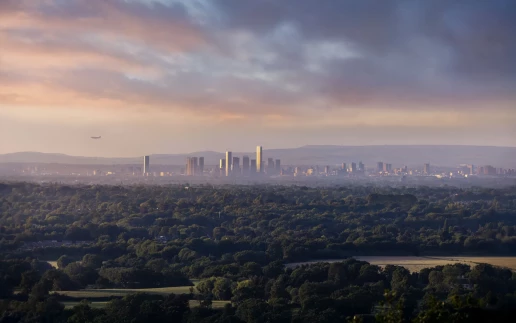
Visualization by ElevenV, created using my panoramic cityscape as the foundation. It offers a glimpse of how the Nobu Tower will anchor the future skyline
Documenting History
We are living through a “Golden Era” of Manchester development. In 50 years, people will look back at photos of 2026 to see how the city transformed from that flat industrial landscape I found in 2006.
My goal this year is to ensure that record exists. I want to move my camera closer to the action—to document the texture, the engineering challenges, and the human ambition that fuels these projects.
It took 20 years, but the Manchester I imagined has finally arrived. Now, it’s time to photograph it properly.